As an Amazon Associate this site earns from qualifying purchases.
Specifications
| Product | Price | Drawers | Frame / top | Stated load limits | Stated dimensions |
|---|---|---|---|---|---|
| SONGMICS BELLAH Collection - Dresser for Bedroom, Chest of Drawers, Storage Organizer Unit, Closet, Entryway, Steel, 5 Drawers, Modern, Ink Black and Ebony Black ULGS322B01S | Check price on Amazon | 5 | Steel frame, particleboard top, non-woven fabric drawers with MDF structures | Top 88 lb; large drawer 22 lb; small drawer 11 lb | Not stated |
| OLIXIS White Dresser for Bedroom, Wide Chest of Drawers for Clothes Storage | Check price on Amazon | 5 (2 large, 3 medium) | MDF boards, steel frames, cross support bars, drawer support shelf | 66 lbs full load | Drawers: L 11.8"L x 11.8"W x 8.5"H; M 12"L x 11.4"W x 8.3"H |
| WLIVE Tall Dresser for Bedroom, 5 Drawer Dresser, Rustic Brown | Check price on Amazon | 5 | X-shaped rear frame, water-resistant MDF top, fabric bins | Not stated | Not stated |
| Sweetcrispy 8 Drawer Black Dresser for Bedroom Tall, Organizer Storage | Check price on Amazon | 8 | Steel frame, water-resistant MDF top, cationic fabric drawer fronts | Top 66 lbs; each drawer 11 lbs | Not stated |
| WLIVE Tall Dresser for Bedroom, 9 Drawer Chest of Drawers, Rustic Brown | Check price on Amazon | 9 | Steel frame, water-resistant wood top | Not stated | 39.6"L x 11.8"W x 40.2"H |
| OLIXIS 9 Drawer Fabric Storage Dresser Chest Organizer Unit, Black | Check price on Amazon | 9 | Steel frame with reinforced crossbars, solid wood top | 66 lbs | Not stated |
Quick answer: Most dressers land between 30 and 36 inches tall for wide/horizontal models and 40 to 55 inches for tall vertical chests, with depth almost always falling in the 16–20 inch range for solid wood and 11–13 inches for slim fabric-drawer towers. Individual drawers typically run 8 to 10 inches deep front-to-back inside and 6 to 12 inches tall. If you're furnishing a rental, a dorm, or a first apartment, the fabric-drawer tower category below covers the same clothing volume at a fraction of the footprint and price — just know what you're giving up.
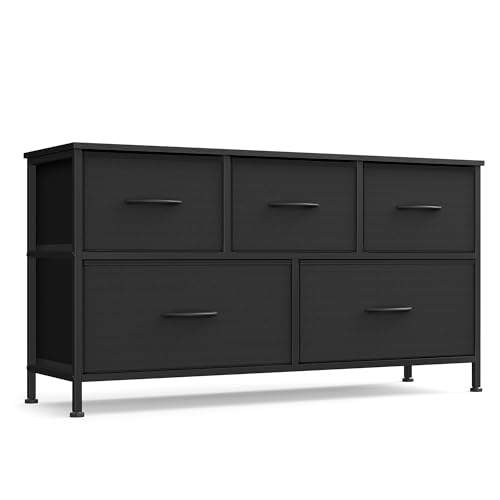
- Fusion That Delights: From the BELLAH Collection, this chest of drawers fuses steel, engineered wood, and non-woven fabric for a perfect blend of strength, softness, and storage
- Ample Storage Space: The top surface is ideal for lamps, clocks, and other daily essentials. The 5 drawers provide hidden storage for your private items, keeping your space tidy
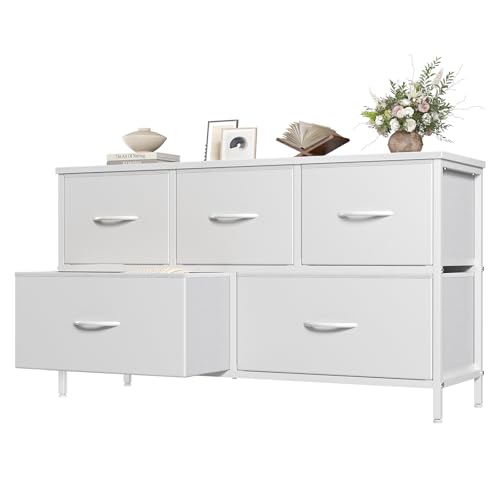
- Multifunction Cabinet: Just place this space-saver drawer in the closet as bedroom furniture to offer a home for workout gear, blankets, and lingerie; place it in the nursery as a
- Large Capacity: This dresser offers 5 drawers, providing sufficient space for daily necessities organizing. 2L and 3M drawers with plentiful space are designed to satisfy your
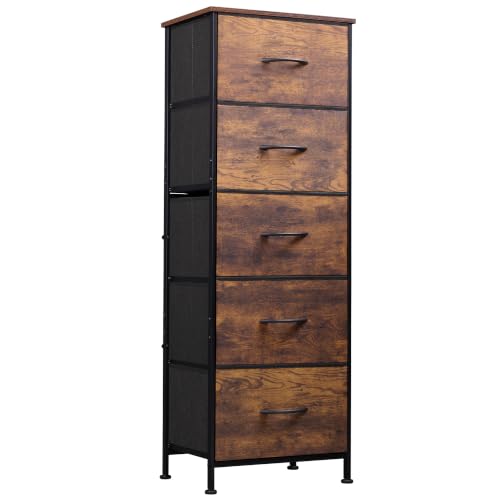
- 【Excellent Storage Capacity】Bedroom dresser with 5 drawers provides plenty of storage space, which can classify your messy items as your need; The wooden table top with good
- 【Lightweight Design】WLIVE tall storage tower with slim and lightweight design to easily move anywhere and fit into smaller spaces, while provides additional storage space for you
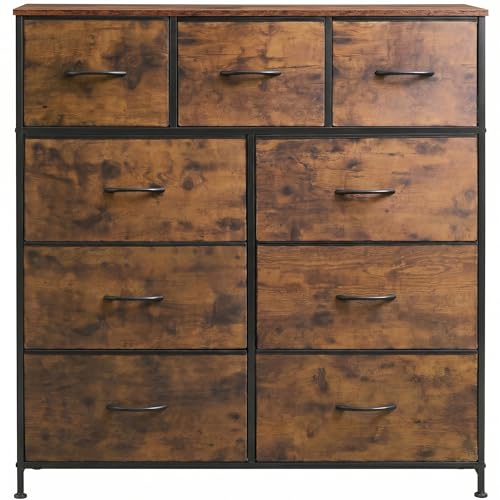
- Multifunction Tower: This fabric dresser for bedroom is ideal for wherever you want to keep clutter under control, such as bedrooms, playrooms, entryways; matches perfectly with
- Roomy Storage Space: The 9 foldable deep drawers are so spacious that they provide endless organizational possibilities. Wooden top is great for lamps, clocks, glasses and other
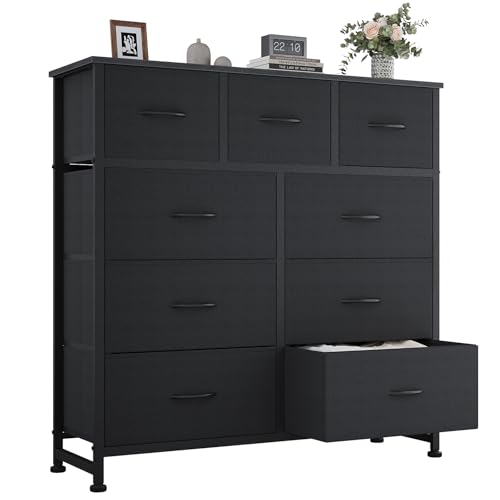
- Versatile Closet Organizer & Storage: This multifunctional dresser serves as both efficient closet
- Ample Clothes Storage Capacity: Designed as the ultimate drawer organizer, this nine-drawer dresser delivers exceptional clothes storage with multiple spacious compartments. The
The dimensions people actually search for
Before the products, the numbers. A "standard" dresser isn't standardized by any authority, but the market clusters tightly:
- Standard dresser height (horizontal/double dresser): 30–36 inches. This is deliberate — it puts the top surface at roughly counter height so you can use it as a landing zone or a TV stand.
- Tall chest / highboy height: 40–55 inches. Narrower, taller, fewer square feet of floor.
- How deep is a dresser: 16–20 inches for traditional wood. Slim fabric towers run much shallower — the WLIVE 9-drawer model below is stated at 11.8 inches deep, which is why these things fit in closets and hallways where a real dresser can't.
- Average dresser width: 30–36 inches for a tall chest, 52–66 inches for a wide double dresser.
- Average dresser drawer dimensions: roughly 11–14 inches wide by 11–16 inches deep by 6–12 inches tall per drawer. The OLIXIS white model publishes exact figures: large drawers at 11.8"L x 11.8"W x 8.5"H and medium drawers at 12"L x 11.4"W x 8.3"H. That's a useful reference point — an 8.5-inch drawer height holds about a dozen folded t-shirts or two stacks of jeans.
The reference point: a 9-drawer fabric chest
If you want one set of numbers to anchor everything else, use the WLIVE Tall Dresser for Bedroom, 9 Drawer Chest of Drawers, Rustic Brown. It's the only unit here with a full published footprint — 39.6" L x 11.8" W x 40.2" H — and that shape tells you exactly what this whole category is doing. It's as wide as a traditional tall chest and about the same height, but it's 11.8 inches deep instead of 18. You lose roughly a third of the drawer volume per drawer and get back about six inches of floor depth, which is the difference between fitting inside a reach-in closet and not.
Finding the right dresser chest of drawers buying guide comes down to matching the features to how you will actually use it.
Nine foldable deep drawers, steel frame, water-resistant wood top rated for lamps and clocks, four adjustable plastic feet for uneven floors. The listing says it ships with instructions and all hardware.
Who it's for
- Graduate students, dorm residents, and first-apartment renters. You need clothing storage now, you may move it in eleven months, and a $70 unit you can carry down a stairwell in one trip beats a $600 solid-wood chest you'll pay movers to handle.
- Anyone with a narrow room or a closet to fill. At 11.8 inches deep, this fits places a real dresser physically cannot.
- People who need drawer count over drawer strength. Nine compartments makes sorting by category easy — socks, workout gear, base layers, seasonal — without deep-digging.
- Households with kids or pets who care that the frame is steel and the fabric is breathable non-woven.
Who should skip it
- Anyone expecting furniture-grade wood. These are steel-frame towers with fabric bins. The tops are MDF or particleboard on most models here; the OLIXIS 9-drawer states a solid wood top. If you want dovetail joinery and a hardwood carcass, this entire price bracket is the wrong shelf.
- Anyone storing heavy items. The published limits are blunt: the Sweetcrispy 8-drawer rates each drawer at 11 lbs, the SONGMICS BELLAH rates large drawers at 22 lbs and small at 11 lbs. Denim, books, tools, or a stack of hardback textbooks will exceed that fast. Sweetcrispy's own listing says it's "designed for light to medium-weight everyday storage" — believe it.
- Anyone who wants to mount a heavy TV on top. Top ratings here run 66 lb (Sweetcrispy, OLIXIS) to 88 lb (SONGMICS). That's fine for a lamp and a speaker; it is not a media console.
- Anyone who hates assembly. Every one of these ships flat. Several listings quote about 20 minutes.
Honest trade-offs
Fabric drawers sag. That's the structural reality of a bin hanging in a frame. Cross supports and drawer support shelves — which OLIXIS specifically lists on the white 5-drawer model — exist to counter it, and they help. But a fabric drawer loaded to its limit will never feel like a wood drawer on a ball-bearing slide.
Anti-tip hardware is included, not optional. SONGMICS, OLIXIS (both models), and Sweetcrispy all list anti-tip kits in the box. Use them. A tall, light, top-heavy tower is exactly the tipping profile that safety recalls are written about. If you have a toddler, anchoring isn't a suggestion.
Drawer capacity is inversely related to drawer count. Nine drawers in a 40-inch-tall frame means each drawer is roughly 4 inches of usable height. The 5-drawer configurations give you taller individual drawers — the OLIXIS white model's 8.5-inch large drawers hold sweaters that a 9-drawer tower simply won't close over.
Price is the point. Everything here sits between $32.92 and $69.99. At that number you are buying a solution to a storage problem, not an heirloom.
What to check on the listing before you buy
Listings change constantly, and the prices above are snapshots.
- Current price. Verify it yourself; these fluctuate weekly.
- Variant. Colour and drawer count often share one listing page. A "5 drawer" price can jump when you click over to "9 drawer," and the black finish may cost more than the rustic brown. Confirm the selected variant matches what you're comparing.
- Stated dimensions on the variant you selected. Only the WLIVE 9-drawer publishes a full footprint here; if the variant you want doesn't list one, check the listing's dimension image or Q&A before committing to a tight space.
- Warranty and support terms. OLIXIS and Sweetcrispy both advertise 24-hour email response. Confirm what's actually written on the page today.
- Reviews. Read them yourself, sorted by most recent and filtered to your specific variant — that's where sagging, missing hardware, and colour-accuracy complaints show up first.
Consider instead if…
SONGMICS BELLAH Collection - Dresser for Bedroom, Chest of Drawers, Storage Organizer Unit, Closet, Entryway, Steel, 5 Drawers, Modern, Ink Black and Ebony Black ULGS322B01S — consider instead if…
…you want the highest published load ratings in this group. The SONGMICS BELLAH Collection - Dresser for Bedroom, Chest of Drawers, Storage Organizer Unit, Closet, Entryway, Steel, 5 Drawers, Modern, Ink Black and Ebony Black ULGS322B01S rates its top at 88 lb and its large drawers at 22 lb — double the per-drawer figure of most 8- and 9-drawer towers. Five drawers instead of nine, steel frame with a particleboard top, adjustable feet, anti-tip kit, and numbered parts with the tool included.
OLIXIS White Dresser for Bedroom, Wide Chest of Drawers for Clothes Storage — consider instead if…
…you need to know the exact drawer size before you order. The OLIXIS White Dresser for Bedroom, Wide Chest of Drawers for Clothes Storage publishes both drawer sizes — large at 11.8"L x 11.8"W x 8.5"H and medium at 12"L x 11.4"W x 8.3"H — across a 2-large/3-medium layout. It's the cheapest unit here at $32.92, rated to 66 lbs under full load, with a drawer support shelf and cross bars, and it's the white option if black or rustic brown won't work in your room.
WLIVE Tall Dresser for Bedroom, 5 Drawer Dresser, Rustic Brown — consider instead if…
…you'll be moving it around. The WLIVE Tall Dresser for Bedroom, 5 Drawer Dresser, Rustic Brown is specifically described as slim and lightweight for smaller spaces, with an X-shaped rear frame for stability and a water-resistant MDF top. It also matches other WLIVE storage towers, so you can add a second unit later without a finish mismatch.
Sweetcrispy 8 Drawer Black Dresser for Bedroom Tall, Organizer Storage — consider instead if…
…you want maximum drawer count at the lowest price. The Sweetcrispy 8 Drawer Black Dresser for Bedroom Tall, Organizer Storage gives you eight drawers for $39.95, with cationic fabric drawer fronts over a steel frame and water-resistant MDF top. Note the honest limits: 11 lbs per drawer, 66 lbs on top, light-to-medium storage only.
OLIXIS 9 Drawer Fabric Storage Dresser Chest Organizer Unit, Black — consider instead if…
…you want nine drawers with a solid wood top rather than MDF. The OLIXIS 9 Drawer Fabric Storage Dresser Chest Organizer Unit, Black pairs that top with a steel frame and reinforced crossbars rated to 66 lbs, adjustable feet, and an included anti-tip kit — at $48.59, about $21 under the comparable WLIVE 9-drawer.
FAQ
How tall is a dresser, typically? Wide horizontal dressers run 30–36 inches; tall vertical chests run 40–55 inches. The WLIVE 9-drawer here is 40.2 inches, which sits at the short end of "tall chest." If you want the top usable as a surface while standing, aim for 32–40 inches.
How deep is a dresser? Traditional wood dressers are 16–20 inches deep. Fabric-drawer towers are much shallower — WLIVE states 11.8 inches on its 9-drawer model. Add the depth again for drawer clearance when planning your floor space.
What's the average dresser drawer height? Roughly 6–12 inches. Fewer, larger drawers mean taller ones: OLIXIS lists 8.5 inches for its large drawers and 8.3 inches for its medium. Nine-drawer towers in a 40-inch frame necessarily give you shorter drawers.
Are these strong enough for a full wardrobe? For t-shirts, underwear, socks, leggings, and light knits, yes. For heavy denim, coats, or books, check the stated limits first — 11 lbs per drawer on the Sweetcrispy 8-drawer fills up faster than you'd think. Split heavy items across a closet rod and reserve the drawers for lighter folded goods.
Related guides
- Best beds and bedroom furniture - bed frames, platform beds, headboards, bunk beds, kids beds, daybeds, nightstands, dressers, chest of drawers, wardrobes After Recent Issues
- Editorial Policy: How Bedroomhaus Researches and Reviews Products
- Best beds and bedroom furniture - bed frames, platform beds, headboards, bunk beds, kids beds, daybeds, nightstands, dressers, chest of drawers, wardrobes for First-Time Buyers
Key Takeaways
- Choosing the right dresser chest of drawers buying guide means matching the key features to your specific needs and budget
- Read real customer reviews and check the return policy before you commit
- Compare value across models — the priciest option is not always the best fit